Burnout: Crying in a Dark Theater

A conversation about burnout, belonging, and the moment a body tells the truth when a life no longer fits.


Burnout does not always look dramatic. Sometimes it looks like a successful career, a stable job, and a life that makes sense on paper. And still, your body knows something is wrong. If you have ever found yourself in the middle of a midlife career shift, questioning your work, or wondering why you feel exhausted even when everything seems fine, this conversation will meet you right where you are.
In this episode, I talk with Ellen Whitlock Baker about the quiet unraveling that led to her line-in-the-sand moment. Years of people-pleasing, pushing through, and trying to belong in systems that were never built for her finally caught up with her in the most unexpected place. Sitting in a theater, watching the musical Beetlejuice, Ellen broke down. Not because the show was sad, but because her body had reached its limit. What followed was a brave decision to walk away from a very stable job and begin rebuilding a life and career rooted in alignment instead of obligation.
This is a story about workplace burnout and listening to yourself before everything falls apart. About honoring the signals you have learned to ignore. And about trusting that even when the next step feels risky, there is another way to live and work that does not cost you yourself.
What You’ll Hear
- What burnout feels like before you have language for it
- How belonging, or the lack of it, quietly shapes our career choices
- The moment Ellen’s body finally said enough
- Why leaving a stable job can feel terrifying and deeply right at the same time
- What rebuilding looks like when you choose alignment over approval
- A reminder that it is not you that is broken; sometimes it is the system
Guest Bio
Ellen Whitlock Baker is the founder and CEO of EWB Coaching, where she helps professionals learn how to prioritize themselves in a world that often tells them not to. With empathy and honesty at the center of her work, Ellen supports leaders in understanding their strengths and building careers that feel sustainable, human, and aligned.
With more than 20 years of workplace experience and certification through the International Coaching Federation, Ellen works with individuals and organizations through one-on-one coaching, workshops, and courses. After navigating her own experiences with burnout and self-doubt, she is on a mission to help others never reach that breaking point. Ellen is also the host of the Hard at Work podcast, which identifies what isn't working in today’s workplaces and explores how we might change them.
Connect with Ellen
Website: https://ewbcoaching.com
Podcast: https://hardatworkpodcast.com
LinkedIn: https://www.linkedin.com/in/ellenwhitlockbaker/
Instagram: @ellenwbcoaching
------
Listen and follow: www.thelifeshiftpodcast.com/follow
Support the show for ad-free and early release episodes: www.patreon.com/thelifeshiftpodcast
Subscribe to the newsletter: https://thelifeshiftpodcast.beehiiv.com/
Matt Gilhooly (00:00)
Have you ever been sitting in a theater, ready for a fun night out, and suddenly your body tells you a truth that your mind has been trying to outrun? That's what happened to my guest Ellen when she found herself sobbing through the musical Beetlejuice, in the dark, next to her family, with no idea why the tears would not stop. In our chat, Ellen shares how that night cracked open years of quiet burnout, people-pleasing, and trying to fit into systems that were never built for her.
and how it led her to walk away from a very shiny job title to build work that actually feels like hers.
Speaker 2 (00:38)
just started crying and I could not stop. And it was so bizarre because I was like, what is happening? You know, it like I was possessed because the musical, again, not a sad musical. Like there was no reason for me to be crying.
Speaker 1 (00:55)
Hey everyone, welcome to the LifeShift Podcast. I am here with Ellen. Hello, Ellen.
Speaker 2 (01:00)
Hi Matt, it's great to be here.
Speaker 1 (01:02)
It is great to see you again, because I had the pleasure of talking to you on your podcast. So thank you for having me. Whenever that was, it seems like it was yesterday, but it was also probably months ago.
Speaker 2 (01:12)
Yeah, maybe weeks. I don't know, but it was awesome to have you and get to know you and your podcast is so cool and it's really an honor to be here.
Speaker 1 (01:19)
Well, I accept that. Thank you for saying that the life shift is really, I, don't know how to say it any differently. So someone that listens to every episode hears me say this very similarly every time, but it has been just a journey that I never could have imagined for myself. It's just like every conversation I get to have with now over 230 something people, a little bit of that conversation. Crazy.
a little bit of the conversation heals some part of me that I just didn't even know that needed the healing anymore. And I think it's that power of connection. And something that growing up, I really didn't have the opportunity because of the time period to really feel. And just a little backstory for anyone listening for the first time because you're on the idea of the life shift podcast exists. Because when I was eight,
I was visiting my father, my parents were divorced, I lived with my mom full time and I was visiting my dad and one day he brought me into his office and he had to tell me that my mom had been killed in a motorcycle accident. And it was, that was my life shift moment. It was a moment in time when the words came out of his mouth in which legit from one second to the next, everything that I knew about my life no longer existed. I was going to have to live with a different parent in a different state, go to different school, not see my friends anymore.
create new friends like everything had changed and it was 1989. It was 1989 and nobody was talking about grief and nobody was talking about anything like that. It was all you keep that at home or you brush it under the rug and I was also a kid so everyone assumed that I was just gonna bounce back and be fine. So I took on the role because everyone kind of made that seem like it was my role and I pushed it down.
And I say all that long winded way of describing that because growing up this long grief journey, I always wondered do other people have these singular moments in time in which from one second to the next, everything has changed. Now in my wise 44 years, I realized we have lots of them, you know, and, and, but there are some that really stick out for people. And so that's what we do on the LifeShift Podcast is
we talked or I talked to guests about these pivotal moments in which one second to the next, everything was different. And how did that change us? And how can we reflect on it and see the resilience in the human spirit? So super into talking about what you're going to talk about today, because there's so much power in story. And hopefully you find that as you tell your story, you said you've, you've talked about this story, but maybe not pieced it together in the way that we're going to do it today.
Speaker 2 (04:07)
Yeah, it's really kind of the first time I'm piecing it together all from the beginning. I talk about it in the podcast, actually. My podcast is where I sort of first said words out loud to tell the story. And I'm still learning it, I think, as I go. And I'll explain what that means later. But yeah, it's not done. The impacts are still happening, right? So it's like this ever-changing story. But ⁓ yeah.
Speaker 1 (04:34)
just so lucky, though, I think, if we have the awareness, and the ability, I understand that a lot of people just don't have that yet, and they don't have the tools. But when we do, to understand our story even more, and see how it can change us even more, I think that's beautiful that your story is still unfolding and changing as it happens.
Speaker 2 (04:58)
Yeah, no,
we're really lucky for that. It's like, it's like a filter was taken off, you know, like everything was a little cloudy and then I had the moment and sort of everything that came after it. And now I'm discovering things.
in a way I never would have before. I'm reading books that I've read before, but seeing them in a totally different light, understanding them differently. it's just a, there are those moments for us all. And I think you're right. If you can stop and pay attention, if you're able to, which a lot of times we aren't, and we can talk about why, it's such a gift.
It's such a gift. I'm just grateful I was able to listen, maybe because the world was shouting at me, but like I was finally able to listen, you know?
Speaker 1 (05:46)
Yeah, did you find power the first time you said it out loud? Yeah. Because did it are things messier in your head than they are when you say them out loud? For me, it's like a hot mess.
Speaker 2 (05:57)
Totally.
And like, that just makes me think of a very specific moment in my life, which is not the one I will talk about today, but definitely as a precursor to it. I remember sitting on my porch talking to my best friend on the phone who lives in a different state, unfortunately. ⁓ And I said the words out loud about the job I had been doing for 15 years, you know, I don't want to do this anymore. And I it was like the first time I had ever
said it and I don't even think I realized it until I said it and because like you're not supposed to not want to do the thing you've been doing for 15 years and you built your whole career around and you know it just never felt like that was an option I guess and that was such a transformational moment because it started me on the path of questioning.
Speaker 1 (06:48)
That gives you the freedom or permission.
Speaker 2 (06:50)
Yeah. And but I like, like you were saying it, I wouldn't have worked that out if I hadn't said it out loud, I think. And that's why it like, I, I try to journal a lot. I'm not a great journal or any, but sometimes, and I find this with my clients too, and I found it for myself to actually write words down, or say them out loud to someone. But sometimes you don't want to say them to anyone but yourself. It makes a huge difference. Like you actually
You can clarify things easier when you do a little bit of that, writing and, and sometimes it's just gobbledygook and that's okay, but it often will get you to this place of like, this is what's happening for me. So there's a lot of power in that. Getting it out of your head. Yeah. And like, even if you're not a great journal or it's still worth trying to do, you know, every once in a while, you don't have be perfect at it, but like,
Speaker 1 (07:36)
getting out of your head.
Speaker 2 (07:48)
few days I'll write something down, you know, and then it does really spark a lot.
Speaker 1 (07:53)
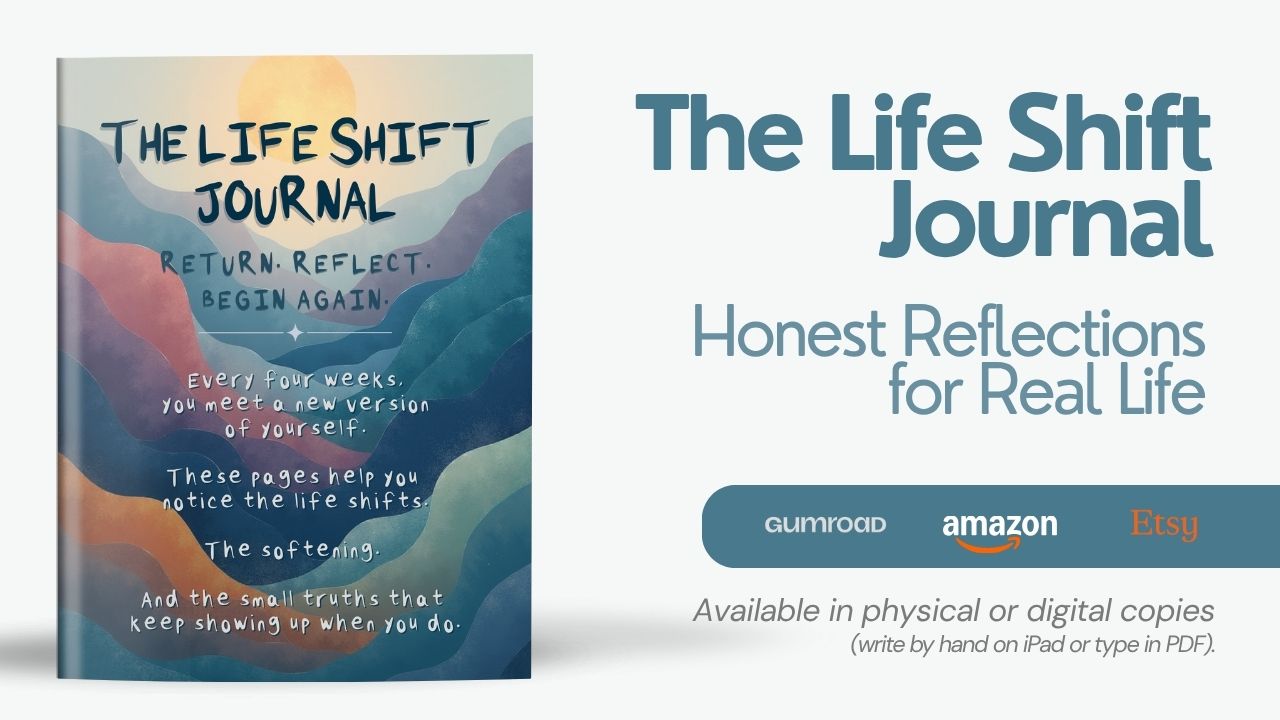
Yeah, no, I'm the same way with journal. I'm very type A. And so I felt like how do I do it right? like, right. Exactly. And then do I modify what I'm saying just so it sounds right or it looks right? And then so that's why I created the LifeShift journal because I was like, I need to create something that like I would actually do and I will do and I do. So it's it's I'm the same way. And I think people are just afraid of it because we're we're conditioned that there's like a right and wrong way to everything.
just like you were conditioned to think like you did something for 15 years, you have to stick with it. That's not a rule. So before we get deeper into your story, let's just let's let's have you tell us who you are at the moment of recording kind of going into 2026. How do you show up in the world? How do you identify these days?
Speaker 2 (08:43)
Well, I am a coach and executive coach, leadership coach. I am a consultant, a speaker, a writer, and I've really been developing that over the last 11 months. I started on this journey of being out on my own in January of 2025. So we're about to hit a full year of doing this, this being solopreneuring, I guess we can call it.
and not working in a workplace that was really challenging for me for years. And so I think I would say I'm becoming. I think that's what you were saying. You have a sticker that says something similar, but like I'm becoming. I'm emerging. you know, I think maybe I'm out of the cocoon, but I'm not fully butterflied. And I'm also, I just turned 46. So like there's this thing that happens in midlife and there was a great Brene Brown
video I saw on it last night, you know, in middle of the night when I was scrolling Instagram, like you're not supposed to do, but there is just something that breaks in midlife, I think. And that's why the majority of people I work with are midlife women, mid-career women, because there's something that happens to us. And I'm sure men too, but there's this moment where we sort of realize, or at least this was true for me, like we gave it all to other people, you know, and a lot of the decisions that we made
for our careers, for our life, whatever, we're for other people first, whether it's our kids, our spouses or partners, our family, the workplace. And there's a lot that goes into making us feel like that's how we have to be. You know, there's this perfectionism and this people pleasing that a lot of us are conditioned, especially who are in our middle ages right now. So this year has been this incredible year of
exploration of what is breaking out of me and sort of pooling on the floor from the before time. Sorry if that's super gross. And of all of that, what is worth saving and what is worth throwing away? And there is a lot that's worth throwing away. So it's been one of the best years of my life. I'm happier than I've ever been in my life. I'm so fulfilled. The work I'm doing is so amazing and it's hard. It's also
You know, we've had a hard year politically, not having great benefits is scary. You know, like trying to do this on your own. There's a reason why the majority of people don't go off and start businesses. It's really hard. ⁓ so I'm learning, unlearning and relearning and just kind of living in that space. So that's kind of how I'm showing up now. And I hope in 2026, which is right next to next door, I'm hoping that it's more of that, but
also that my feet maybe hit some solid ground a little bit more and I can be more confident in the way I'm going, you know.
Speaker 1 (11:44)
Yeah, no, I think that's beautiful. And it's like, part of me is like, I wonder if you think, man, I wish I could have done this in my 20s, or in my 30s. But at the same time, it would mean something totally different, right? Like you wouldn't have had all the experiences that make this. Well, I'm just making a grand sweeping assumption, but you wouldn't have that all these experiences that make this that fulfilling now.
Speaker 2 (12:10)
100%. Right. Yeah. It's funny because I think about, ⁓ when I was in college, my undergraduate degree, I was an acting major or theater major. We had these classes called Meisner, the Meisner technique. If anyone listening is a recovering actor, you will cringe hearing that. But it was basically this technique where you like...
you had to really feel whatever it is you were acting. And so like you go into your deep dark history and like try to remember a time when something bad happened to you so you can cry or whatever. I'm definitely making it simpler than it is, but it's about like pulling on your own grief or lived experience to authentically act. Not sure it's the greatest method now that I look back on it, but
I had such a hard time because I didn't really have anything bad happen. And I say that knowing how much privilege I had and certainly I had, you know, shitty days at school and I, you know, had bullying and all sorts of things like all kids have. But I had great parents who loved me a lot and really didn't stand in my way ever and let me do what I wanted to do in terms of like fulfilling my dreams. you know, I was...
21 maybe 20 like I just had had a pretty good life and so I could never find that space and I joke that if I had go back to acting now I would be amazing because I've lived all this other shit, you know since then so I just that was a long answer I guess but No, I couldn't have done this in my 20s and 30s. I I had to do this in my 40s And I think that's what happens to a lot of us. It's like I don't know what it is. I don't know if it's perimenopause and it's hormones. I don't know if it's
maybe just what's going on in the world right now, but it does seem to be a big turning point for us to say, you know what, maybe I can do stuff a little differently and it doesn't have to be like this, you know?
Speaker 1 (14:06)
Yeah, I think I saw a lot of people through the pandemic that kind of were able to take a little bit more time, unfortunately, for so many, but also fortunately for some to realize like, what was serving them what they wanted to do. And so I think that that also is probably a trigger for some that are now realizing that maybe there's a different way of doing and being
And so I think it's beautiful that you found that. And although you're, said your answer was a little bit long, it wasn't because you kind of started painting the picture of, who you were and how you kind of started to grow up and, and coming from a seemingly beautiful upbringing in some way, like no, no major thing. Like for me, I became a perfectionist because of my trauma. But curious, like, it sounds like you had a pretty quote unquote normal existence as a
as a child and teenager.
Speaker 2 (15:04)
I did and therapies uncovered a lot of what I thought was normal that maybe wasn't the best way to treat myself really in a lot of ways. there's, like you were, you were saying to me when we were talking earlier about like imagining that you're talking to the eight year old version of yourself. And I love that ⁓ it's IFS, right? I think it's called integrated family systems or something like that where you're
basically naming the different parts of your sort of psyche and you're talking to them. You're having conversations with them. And there's a great book by one of my favorite authors, Britt Frank called Align Your Mind that just came out this year. That's all about that. And so my therapist had me do some of that work where I was like talking to, like actually talking to, and I felt really silly the first time I did it, you know, seven year old Ellen or the Ellen in sixth grade that
I got taken to a nutritionist because I was overweight and it kicked off just decades of disordered eating and horrible self view and just a lot of very challenging things for me that I wish I could tell that girl now that, screw what they say, it does not matter, you're just fine.
⁓ it's so 1990s, it would have been like 90, 91. And then, you know, my mom and I, cause she was in the same boat and we did all of that. Like, I don't know if you ever did or heard of it, but Dr. Dean Ornish was this like low fat. Okay. And so we were basically eating like snack wells. don't know if you remember those, those like low fat cookies and you know, yes. And like chicken with nothing on it.
Speaker 1 (16:32)
very 1990s.
Chocolate brownie ones are delicious.
Speaker 2 (17:00)
And it was just sad and there's such a better way to deal with all of that now, although it's still, you know, I have a daughter and that stuff is hard. ⁓
Speaker 1 (17:09)
to
eradicate. Yeah, it's interesting too, though, because I think having experienced disordered eating in my teen years as well, it becomes part of your or it became part of my being. It became the control element of it, which then led into, you know, college and getting jobs and the control element was always there, whether it was disordered eating or it was some other part of my work. Did you?
Did you find that the control element as you got into adult life transitioned or did it stay disordered eating or both?
Speaker 2 (17:47)
it stuck around and like, for me, was more it was the eating was my comfort. So that's really where it kind of how it manifested for me. And so I came to just like need and require food, like not good food. ⁓ And a lot of it when I was sad or mad or whatever.
And so it's, I'm trying, it's a little bit different, I think, than the perfectionism that might come with like aggressively, you know, very meticulously counting calories or, know, depending on what kind of ED you may or may not have experienced. But for me, it was more about not emotionally processing things and eating instead. So it was sort of like what I turned to. And then, you know, when I went to college, for some reason, like I, kind of, think it was like,
right now is a renaissance of myself. Like I discovered myself for the first time, lost a ton of weight, was just like super cool with like eating wasn't the thing I thought about all the time anymore, you know, and then the more and more depressed I got and the more and more I sort of slid into that feeling of I don't know who I am anymore and that renaissance is long gone when I was in my 30s and 40s. That's when it all snuck back.
And so in this last year, it's been unlearning a lot of that. I really credit my therapist for this, but actually learning how to connect to the feelings that I'm having, which I grew up in a time when we just like, we don't really talk about them. My parents were very cool. They're like, we expressed ourselves and we said, Matt, when you did that, it really hurt my feelings. And we sat down and we had very orderly conversations about it. But...
know, when we were in like a big emotion, we were supposed to go away and then like come back when we were calm. And there was something about that that led me to just feel like just not be able to really feel my feelings until they were over done. And so, you know, that's when you're like cry at work and you really don't want to cry at work. like
you can't stop it. It's like this physical thing, which I've since learned is kind of my stress response too. it was so unhealthy. that's where the eating and the numbing that I was doing. And I was just really doing that, especially towards the beginning of the end of last year, which is where I had one of my big moments.
Speaker 1 (20:30)
Yeah, lead us up to that. tell us what happened in between. mean, I didn't mean to take you down to eating disorder eating pattern. But I think it's important. I think we should talk. I agree, because I can pretty much guarantee you that the two of us were not the only ones with disordered eating patterns in the 90s. Right? Like and, and maybe fewer guys, but maybe not. You know, I think we all have these, these
I had a situation in which, you know, my father said, you need to lose weight, you're too big, you know, you've gained too much weight. And I was like, 12. And since then, and I don't think he said it with any mal intent. And I don't think it was anything like, I think he was literally concerned. And it was the time period, it was just how it goes. And but that plants a seed in, in, in us, and we kind of navigate our world.
little do we know in the workplace in all the things we do just from little things like that that become bigger.
Speaker 2 (21:31)
It's so huge. I mean, that's a great example of impact versus intent, right? Like, sure... I've talked to my parents about the whole, you know, going to a nutritionist thing. And it's so funny, I can remember such specific things about, like, I remember what it felt like to be in the office. I remember the sound her pen made on the paper and like how neat her writing was. Like, it just was so weird.
that there's these really physical memories that come along with that, you know, experience, which was, was, it wasn't like anyone was yelling at me and saying, you know, you're horrible, but it was like, oh yeah, you need to do all these things differently. Because the way you are isn't good. Right. And I wasn't even really that overweight. was just slightly bigger, you know, and I was 12. I was 11. I was 12. Yeah. And
Speaker 1 (22:21)
You were a teenager. You were 12.
Speaker 2 (22:30)
there's that indelible impact. And as a parent, it's terrifying because I'm constantly like, God, what do I say? And watching my daughter now as a preteen start to think about weight and appearance, and she's so much more confident than I am. But I find myself being like, you need to some protein. You can't just have Takis for breakfast.
which is probably good advice, honestly, but you know, it's like, I have to really watch what I'm saying to her. anyway, the cycle is, it's a long and challenging one, but yeah. So let me, I will tell you a little bit about where I got to where I was. So I am an only child, which I think plays into this a little bit. My parents were 35 and 38 when they had me. So definitely always been a little bit older for my generation. I was 35 when I had my daughter and I'm
mostly on par with the parents. So I think it's changed a lot since then. And I grew up in Hawaii. So I was born and raised in Honolulu. My dad taught at the university there and my mom worked and kind of a latchkey kid. But the interesting thing about growing up as a white person in Hawaii is that you are usually or often the only person in the room who looks like you. And I think that's a good experience for anyone to have. And I'm really...
grateful honestly for that experience. mean, Hawaii is incredible and I'm grateful to have been born and raised there. Because I think it really, it has so many different cultures coming together that you learn so much about lots of different people and ways of doing things. And the food is just, you know, every birthday party was an incredible smorgasbord of like,
know, Japanese food and Chinese food and Hawaiian food and Filipino food and Korean food, you know, it was just so good. So I felt I feel really lucky and it was hard. I felt really lonely sometimes, especially as an only child. So I realized when I was older and was first kind of going through the values exercise of like, okay, what are my core values that belonging is one of my core values. And it when belonging is threatened, I feel that is really something that
brings out that's really hard for me, you know? ⁓ And so that translates to like the workplace. When I feel like we're not creating a workplace where people feel like they belong, or when I feel like I don't belong, it really starts to tip the scales for me to not feel good. And I say all that because I was really experiencing that in my role.
⁓ you know, especially like during the pandemic, think you're right. Everything shifted for a lot of us. We were able to be like, this is what it's like to not commute every day. And, know, I had so much more time with my family. started a garden. went vegan for a while, which did not last long because we love cheese, but you know, we just had, we got a dog. Like we just had this really.
the best experience you can have in a shitty situation and not to make light of what was going on because it was horrible. But when you're sort of thrown together, what are you going to do? And so I was just kind of reminded of how it was like to be with my family more often because I had the kind of job where I was gone a lot for events and travel and was taking care of my body with this great food I was growing myself, which I'd never done before.
So I had started to unravel then. Like, really, that was when I start. And I had just turned 40 right before the pandemic. like, the workplace that I thought I loved was starting to show its true colors to me. And I say that to say like, someone else might have been in that same workplace and be listening to this and have had a great time and still be there even.
that's totally okay. It wasn't for me, you know, and there were things that really started to show up for me, especially after the racial reckoning and George Floyd's murder and, you know, how I learned a lot really quickly about how people who did not look like me were experiencing the workplace that I just hadn't realized before. And that's, you know, that's where we talk about white privilege, right? Like I
Certainly, again, where I grew up, like I grew up around a lot of people that didn't look like me. That wasn't something I was unfamiliar with, but I was unfamiliar with the fact that the norms in our workplace just really, really don't work for lots of people. I knew they didn't work for women in a lot of ways, but like, really, especially with learning about Black Lives Matter and
everything that was going on. were so many amazing thought leaders that I learned about and started reading during that time who taught me a ton. I still like one of the things I say to everyone is like, go out and find those people to learn from who are not like you, because there's so much out there that you don't know. And it's our job to do that, I think.
Speaker 1 (27:59)
⁓ yeah, 100%. And so hearing your story, doesn't, it sounds like the culture or what you were experiencing or seeing maybe for the first time, or maybe you were seeing because you were looking for it this time, instead of, you know, maybe just assuming before. And so it was more that unless, like, I hate this, the tactics of this job or the things that I do besides the fact that like,
pandemic shows me like there is joy when I'm not
Speaker 2 (28:33)
Yeah, it's not all about work. ⁓
Speaker 1 (28:35)
But it wasn't
necessarily like the day to day job or was it a mixture?
Speaker 2 (28:41)
It
to become a little of both, but at the beginnings of this sort of like, okay, I'm 40, we're in this pandemic. I'm really getting my privileged world shaken and doing a lot of learning and unlearning and that's really uncomfortable and hard and everybody, you know, we were in a really hard place. So it started with that, but then that led me to...
not always agree with the policies. And I was on the executive team. And so I was part of the leadership. And, you know, when I started to voice opinions that were different or different ways of doing things, those weren't always welcomed. And that's okay. Again, like it's, everybody has a different prerogative. I've also, when I was first figuring out what I was even disagreeing with, I probably wasn't that.
you know, well spoken about it or was emotional about it because it was an emotional time too. So none of this is to put blame on anyone, but it started to really not work for me. And that's when I started to kind of question.
Speaker 1 (29:53)
it triggered your sense of belonging.
Speaker 2 (29:55)
the whole thing, a hundred percent, it triggered my sense of belonging. And the only reason I knew that is because I'd been lucky enough, the same workplace paid for a coach for me who's life changing. And that's actually why I went on to become a coach because she helped me realize that was one of my values. And my other value, my other core value is wholeheartedness. know? So it's like, I'm this very earnest individual who wants
people to feel like they belong. And that does not work all the time in a very politically charged workplace, which I knew how to play the game. Like I went into it knowing how to play the game, how to get the promotions to, you I had multiple. Yeah, I got, my gosh, 100%. And I checked it all off and.
Speaker 1 (30:44)
Checklist
Did it bring happiness like they promised us?
Speaker 2 (30:51)
Not at all. Did it for you? No. Yeah. And that's now what I'm like, my God, we are so broken in so many ways because now living outside of the bubble of what is expected of me and just sort of living with what I expect of myself, it's so different, you know? And that's ultimately where I got to at the end of this journey. But so there is hope out there.
But I felt really trapped. And so this is where I think this might resonate with a lot of listeners, because this is very true for a lot of the people I coach. I was the sole income earner for my family. My husband was managing. Our kid was in kindergarten and first grade during the pandemic, so needed attention. And I was in back-to-back Zoom meetings. And so.
I was the income earner. I was getting the benefits. My husband's a type one diabetic. I have medical conditions. not having insurance is just a non-starter for us. So it felt like there was no other choice. You know, like I had to stay. And then another job opened up at a different institution locally. And it was sort of one of those, there are only two or three jobs that were at the level I was looking at in the industry I was in. And so.
I applied for it and got it. And I think I knew, like, as I was making that transition, it maybe wasn't what I wanted, but it felt like what I should be doing because it was like the next step up. was an assistant vice president role, right? You know, and like, I was in charge of the whole team and that was a checkbox. That's my next checkbox, 100%. And I had benefits and I had the salary and I was had more salary. So it was better, you know, and then it just
kept unraveling for me while I was there. Like I just kept being like, wait, why are we doing that that way? Or, you know, this feels not good. And I have to credit my team that I had there were amazing. And a lot of them were younger millennials. And I say that not to say that everybody acts the same in different age groups, but they questioned so much.
And I really, really needed that. It made me actually say, well, you know what? I don't know why we do it that way. Let me find out. then sometimes I have to come back and be like, no one knows why we do it that way. We're just supposed to do it that way. so it was really uncovering a lot of my own biases and my own learned experience and undoing that.
We have to do it the way we always have been told we have to do this life checklist. We have to do it in this order. And I really learned to let go of a lot of that because of that experience. So I'm grateful for it, but I was just miserable because I didn't feel connected or aligned with the leadership writ large. And I felt very alone. that belonging was really showing up.
for me because I didn't, I felt stuck in alone, you know, and I had started taking coaching, going to coaching training. And so I knew that that was probably going to be my long-term goal, but you know, it didn't seem like it was possible anytime soon because you know, salary and benefits are cool. So, right. And it was not safe at all. was a very, it was a big risk. And so I thought I had to stay there and
Speaker 1 (34:23)
safe, right?
Speaker 2 (34:32)
It got worse and worse for me for a lot of reasons. And the moment that like the life shift happened was I was, you know, I'd had just a run of bad months, you know, just bad conversations, resources getting cut, like just not being able to do my job, not getting any purchase. I felt like there were things I was saying that people weren't listening to and, know,
Again, my experience, not everybody's in that workplace, but mine was not good for a lot of reasons. And I was finding myself like crying on my way into work and crying on my way home and not really knowing why I was crying necessarily, just that I was really upset, you know, and that goes back to the feeling your feelings thing and how that's, you know, sort of hard. But I was attending a performance of the musical Beetlejuice.
Which is a great music. I'm a huge musical theater nerd. So have you seen it? Yeah. my god. Love it, right? Not a sad musical, not sad, which is important for the story. But I had met my husband and daughter for dinner and I had come straight from work to meet them there. So that always felt like a little sad because I didn't get to like go with them or whatever. And we had dinner and then we went and we sat down in the theater. And as soon as the lights went out, I started just kind of like it was like that.
dark in that piece and maybe it's because I was an actor and I had lots and lots of time in theaters growing up and in my early 20s that it's a safe place for me. I think that might have been what happened, but I just started crying and I could not stop. And it was so bizarre because I was like, what is happening? You know, it was like I was possessed because the musical, again, not a sad musical. Like there was no reason for me to be crying, you know, while they're dancing and talking about death in a funny way.
And, and I have never had that happen before where I couldn't stop. Like I could, I just, it was just like coming and like to a sobbing place where I was trying, I mean, I was very like, you know, trying to keep it in. So my daughter didn't notice and she was on the other side of my husband. So she didn't, but my husband was like, what the hell is wrong with you? You know, he was like worried about me and it was my, I broke, like it was, it was the point where I broke and
Speaker 1 (36:56)
Legit
your watershed moment. I'm broke. Yeah. Well, there's only so much we can hold in.
Speaker 2 (36:58)
100%.
It's so true and that's where I get now because it's like, we are conditioned to hold a lot in and not talk about this stuff and think that we're bad for feeling it, I think, at work, which we can get into later, but like.
Speaker 1 (37:24)
Yeah. I think you're conditioned also, or we are conditioned, we're a similar age group. We were conditioned that we need to be grateful for these jobs as well. that, like not everyone gets the chance to be vice president or assistant vice president or, know, like whatever it may be. And so therefore we can't dislike it. We can't complain about it because how lucky are we not to mention the fact that we worked our butt off to get there because that's what people told us to do. But at the same time, it's like.
I should be grateful for this. So that adds to me, it adds another layer of feelings, right? Like, because now you're like, why am I not grateful? Am I broken? Like, and then so then you have that plus your, your trigger of just not feeling that belonging sense of people not kind of a space that doesn't feel right to you, because they're not choosing the things that, like, maybe would feel more aligned or whatever that may be.
Would you say that those built up experiences was more like a like a soul suck? Or is it more of a burnout of like, I'm just just dead to the world when work is over kind of thing? Or is it more like, I'm going in and I feel like I just have to shed all of me just to survive? And are they different? I don't know.
Speaker 2 (38:48)
think they're, they can be and they can be the same and they can be part of a whole journey. I would say I felt that soul sucky thing more at the, like I was feeling that and then it turned into the burnout where I was, you know, and I live in the Seattle area and it's really dark and cold for a lot of the months. Like right now it's almost dark and it's like 351, but it was,
It was this, I had never felt like this before where I was, you know, crying on the way in, crying on the way out, just trying to make it through the day, trying to initiate as little as possible. Like by the end of my time there, I was just like, how can I stay under the radar? Which is so anathema to what I learned and what I've always thought I had to do, which is be out in front and do all the good things and be seen and you know,
So it was like, I just gave up, you know, near the end. And everything was hard, you know? Like I came home and I didn't want to do anything. I didn't want to be with my family and I didn't want to, I just wanted to read or watch TV and escape. that numbing, and that's where the eating was coming in too. It's that like, I just wanted to numb. ⁓ And I disengaged from, you know, a lot of...
Speaker 1 (39:51)
shell of yourself.
Speaker 2 (40:16)
my things that I did that I loved and I left it all at work. If I had anything to give, I did it when I was working with client customers essentially at work where I had to be forward facing and I gave it all of them and then it was gone.
Speaker 1 (40:32)
But then you went to a love of yours, a love of your life, this theater moment in which should be a beautiful escape. But I love that you kind of correlated that space for something that felt safe. It probably held a lot of maybe not that specific theater, but a theater holds a lot of fond memories of things that you had done and the people and all those things. And maybe it was like this little hug of like, okay, your body just needed to like,
let it out. And sometimes we can't predict what's gonna happen. We definitely can't force it. You know, and so it's beautiful that you had it. I mean, in a funny musical, it just makes it it just makes it that much more important. I think if it had been in a had you gone to see the notebook musical, and you were crying, then maybe you wouldn't maybe it wouldn't have been as impactful, right? Because you might have associated well, it's a really sad moment or
those things. So this stands out even more, because it was, is the antithesis of what you should be doing in that, in that moment. And so you have this eventually, I'm assuming you recover from the sobbing and the show. And hopefully you got to enjoy some of it. But what happens next? Like, what does that? Does that give you like, ⁓ I really need to do something? Or was it
Speaker 2 (41:56)
I
knew I was like, okay, that means that that is a shift. That is a shift. Something has shifted. There was this weird funny journey I went on afterwards where I got asked to apply for this job in London. It was right after or during, I can't remember, it was right around the same time as this breakdown in Beetlejuice.
I was like, huh, London's really cool. Like maybe I should pursue it. And, you know, we weren't really thrilled with the way the political realm was going here and, you know, kind of nervous about it. And so, okay, why not? It could be fun to try it. So I ultimately got to a place where they flew me over for an interview and my husband came with me and we went a little early and we just like kind of
we'd never been there. So we like went to the neighborhoods that we would like possibly live in and just like we just wanted to feel it out. Like what would it be like to live there? And I mean we were obsessed like it's amazing and obviously it has its problems too but like I have been obsessed with England forever. My grandfather's from there so I must have it in my blood but like yeah obsessed. So
we were doing all this and we were like, well, you know, this could be, and we were having this big like existential like, and it was funny as I was going through the interview process in London, I was like, God, I don't really want to do this. Like I really could feel, cause it was the same role I had here, but just in London. And I know I did well in the interview, but I'm pretty sure I didn't give, like I definitely was not like, I'm so excited, you know? So.
I didn't get invited, you I didn't get the job. And that's when my husband and I, we were there and we went out to dinner. It was our last night there. And I was like, okay, I am now, I'm done. I cannot do this job anymore. Like that was, I'm glad we did that. And we had a lot of time during that week because it was just the two of us and we never go on vacation. So it was sort of this weird vacation that we took and we had a lot of time to talk.
just the two of us about the future and like what was happening. And so we really got that space to be together and, you know, think about big life decisions. And so that's when I decided and I came back from that trip and went in and met with my boss and was like, Hey, he knew I was, you know, going out for the job. And I was like, Hey, it was a great trip. Really enjoyed it. ⁓ didn't get the job. Also I'm done.
Like, I'm no longer going to work here in a nice way. And I stayed for like two months, you know, I closed it out and I did all the things, but it was, it was that moment in, in Beetlejuice where I just like, I, it's so interesting to talk to you about now, cause I do think there was a safety and a warmth and a, ability to feel that I felt because theater has always been that safe space for me. So that's so interesting. Cause I hadn't really thought about that, but.
I think it just allowed me to say, okay, this is the sign that I'm done. I have this other weird sign that I might need to go to London. So I'm going to just go pursue that really quickly. And then it wasn't for me and great. then I really
Speaker 1 (45:24)
confirmation. it was your way. Well, also, like, I think it there's something to be said about, I'm going to give it one last try. And things didn't align. And so it's the reminder of, okay, I was right. Like, yes, this is not a test, right? It was a test. And you did your part, you did your very grow up, you know, born in the in the
late 70s, early 80s. I was trying to do math real quick. And you were, you know, you were, you were doing the part of like, okay, I have this was offered to me, I have to do it. But you knew. And it was just this beautiful universe saying, this isn't, this isn't your direction. But it's scary. Like, how did I mean, I love that you had this time and this space and quiet probably to talk with your husband about like, true, like,
We need to figure this out. But also you're the breadwinner. How, like how, how are you able and not this is not a financial question, but how are you able to make that decision that like, okay, I'm going to do my own thing and we're going to be okay. Cause you also have a child who is in less than 10.
Speaker 2 (46:39)
Yeah, I want to answer that, but I want to tell you this, just the absolutely bananas thing that happened to get me to London and it's very quick. when I was interviewing for the job, I was like, ⁓ I don't know if I should do this or not. I don't know. And my husband was renovating. have like a little cottage on our property and he was renovating it. And he was, he had moved the fridge out of the kitchen and had ripped up this like
ancient linoleum that had been there for years and he found this. I don't know if you can see it. It's a magnet that says London on it under the linoleum under the fridge that had been there for decades. And he came in and was like, I found this and I'm getting goosebumps. It was like, well, I guess we have to go. Like there was no question then, right? Like it was like, clearly we have to go. And I think the reason for that was
because we had to have those conversations with each other and that time with each other, but it was such a weird, it was so weird. That was another big shift moment, right? But like, like the oddest thing, right? So this jumping off was really risky. And you know, it's not lucrative yet, you know, and I'll say that honestly, because I think we have to be honest with that.
I was lucky to get some support from my parents. We had some savings. We have some support from his mom and she's now living with us. So we've been able to kind of in the cottage where the London magnet was. ⁓ So we've been able to kind of combine expenses a little bit. you know, I was way off in what I projected for what I would be making versus what I am actually making. And I hadn't really thought about the costs that had to go into the business because
I'm sitting here thinking, there aren't any expenses. mean, I'm just here in a room. There are so many expenses, ⁓ especially things like trainings. I'm learning. I got certified in how to do the disk assessment because that's a skill that's really useful when you're coaching. doing like, I have a keynote coach right now who's helping me with a keynote speech. So all of these things that I know will pay out in the long run, but they cost money now. So it was.
Speaker 1 (48:58)
Was it belief?
Speaker 2 (48:59)
Yeah, I think so.
think it was a combination. And I know there are other people out there who have gotten here of, literally cannot do this anymore. And I see that is a place of privilege that I could actually leave. So I do acknowledge that. I couldn't, especially because I had that moment in Beetlejuice. was like, this is, I never.
Speaker 1 (49:21)
But you couldn't see any other future.
The irony ⁓ there is the whole, being dead thing. like, you know, and I think, right. And, but I think there is some, there's some kind of like, you could have stayed on that path. Like, technically you could have stayed on that path and lost yourself in the process, like even more so than you were. And so many people do that because we think we're supposed to, or we just don't have the epiphany of the
Speaker 2 (49:31)
Exorcism.
Which is a song from the musical, folks.
Speaker 1 (49:59)
something that is driving us to do something differently, something that feels more aligned, which it feels like despite it's only been a year, which is a long time, but also like not a long time. You know, it feels very aligned for you despite not maybe making the money that you expected yet. ⁓
Speaker 2 (50:17)
Yeah. I mean, I'm not making my salary yet, but that's six figure salary. Like, you know, I can't get there yet. No, not one. And that's where I think I may, there may be something wrong with me or maybe it's just what hope looks like, but I've never been happier. And I've never, even though I'm like staring down a dwindling bank account and the, the thing that with
Speaker 1 (50:21)
regret
regrets come with it.
Speaker 2 (50:46)
with our current president being elected, a lot of the places where I would have gotten pretty easy, low-hanging fruit business from lost a ton of funding, the public sector, nonprofits, all of the NSF, NIH grants, all of that. That was kind of my area of like the easiest connection. many of those places stopped even having funding to spend on a consultant or a coach. So a lot of the stuff that I thought would be easier just changed overnight. And
Every coach I talked to said, is like, has been one of the harder years because people are out of jobs, they're losing money, they're laying people off. It's just not a time of ⁓ great expansion.
Speaker 1 (51:30)
Maybe
knowledge. Well, yes. But I think maybe an opportunity for you to take the time to get all the pieces together. Right. And to create I think, I don't know, like, I don't want to take this away from you. But you said, you know, maybe it's the hope. And I think it's more not knowing you very well. But it feels like when someone clicks in with something that feels very heart centered, purpose driven.
It's more about the alignment and it and you feeling like you're no longer putting like a square peg in a round hole. Like you're actually the right piece for the puzzle and all the other things in a previous version or if you were doing the wrong thing, you'd be like dwindling bank account. Holy crap, you know, and you'd be panicking. But because this feels so right, dare I say, maybe that's, that's what keeps it going. That's what fuels the fire. That's what
Like it must feel like you know you're doing the right thing.
Speaker 2 (52:33)
That's exactly right. Like, yeah, it's this alignment that I've never felt in my life. And it's taken this whole year to heal from where I was. ⁓ And it's been a really interesting journey in that respect. Like there were the first few months, I was still kind of hibernating because it was...
I was like so tired all the time and I would go and sit by the water because I live by the water and just like cry, you know, and I sound like I cry a lot. I don't actually, it just kind of happened to be and it is okay, totally. But I think the reason I say that is because it was unexpected for me and it was this like, it was this letting go and I cry more now because I think it's easier for me.
Speaker 1 (53:14)
And if you did, that's okay.
Speaker 2 (53:30)
to like express the emotion that way.
Speaker 1 (53:34)
I mean, you're you're you were you had society's identity that was kind of placed on you that you happily maybe not happily absorbed right growing up because of your generation. And now you're finding your your true identity. So I think there is a shedding of, of the elements that come with that. Like, there has to be a I don't know if there has to be but I feel like there is a sadness. Sometimes when I look back on the things that I chose to do professionally.
Like, why did I do that? do I miss a piece of that? Do I, you know, like, so there are probably pieces of the life that you live for 15 plus years or whatever you said, ⁓ that, that you miss, but is that true? there pieces of that life that you miss besides the salary paying your bills?
Speaker 2 (54:23)
Benefits? yes. And I'm trying to think of exactly what it is. Part of it is I feel some sadness that I stayed there for so long in that, not there being the workplace, but there being in that space. I'm sad that I'm 46 and just starting to figure out who I am and reclaim who I am, to use the word. My friend Kat uses all the time.
Speaker 1 (54:26)
and
Speaker 2 (54:54)
there's not a lot I miss about the actual work and I think I'm I'm I regret which is a hard word. I wish I could have figured it out sooner and just like we were talking about earlier I couldn't have you know I had to live it until yeah I was not there and so I would say if there are people in that situation who feel ⁓
you know, maybe at midlife, maybe at mid career or not, but just feel really, really stuck in a place where they no longer feel like they belong. It absolutely gets better. And it gets better because you start to reclaim yourself, believe in yourself one little bit at a time. It's not, it's, you know, it takes, I know I talk about the shift and you talk about the shift, but to get to that shift moment,
there were lots of little shifts along the way, know?
Speaker 1 (55:56)
Yeah, perspective change, know, perspective change, or, you know, all the things that you're doing now, you were probably doing little pieces of in previous versions of yourself. And now you're able to kind of piece them all together and in a beautiful way to help other people kind of pull themselves out of moments that that in which we feel stuck, because we're not really stuck. mean, unless we're in a dire situation in which we there's nothing we can do about it at the time. But
You know, I think it's, I think, I think you're right. I think you can't, you can't regret too much because it's already done. How many stories do we hear about people that actually start brand new careers like yourself in their forties, in their fifties and have a long successful new version of their career? So I think, yeah, you're 46, but you're 46. Like, you know, you're not a hundred. So, no, there's a lot of opportunity for you there. And I think that.
that a lot of people can relate to your story because so many of us bought into what we were supposed to do.
Speaker 2 (57:01)
Yeah. Yeah. Yeah.
Speaker 1 (57:04)
So
I'm curious, and I don't know who I want you to ask or say something to, but I'm wondering if you could go back. You could go back to the Ellen who was crying all the way to work. And if there's anything that this version of you that's still becoming, that's out of the cocoon, but getting a little bit of the butterfly in you, is there anything you'd want to say to her?
Speaker 2 (57:33)
I mean, I wanna say.
Like I've like, mean, it gets better, but that feels sort of trite, but it does. And you're not wrong. I think because I spent a lot of time trying to fix myself to fit into this place that was just not made for me. ⁓
And I do think that, I mean, if you look at most of the like books or talks or podcasts or whatever about burnout, they're often about like, what can you do differently? When it's actually a system that's really, really broken, that's causing the burnout. So I think I would like to have said, it's not you. know? Yeah. And it's going to be okay. And it's okay to be here and you're going to be okay.
Speaker 1 (58:23)
This can be okay.
Yeah. And you're going to figure this out and you're going to be happy and you're going to be aligned and, and all the beautiful things that you probably wouldn't have believed you at the time because I wouldn't have felt so dire, but you know, it's very common all, all the time. I asked this question and most of the responses are, it's going to be okay. Cause in the moment we don't realize how powerful we are, how resilient we can be, how, how things can change on a dime.
And, you know, we just need to know that we're going to be held and that we're seen. So thank you for doing that little experiment with me and sharing your story in this way and just being a part of the LifeShift Podcast. It's just a pleasure.
Speaker 2 (59:08)
Yeah, thank you so much for having me. That was an important thing for me to do, I think. I didn't realize that. But thank you for giving me the opportunity.
Speaker 1 (59:15)
Well, thank you for sharing with everyone listening. And I think that what your story is, although unique to you, not unique to the planet. I think there are a lot of people that have been in the same experience or feeling the same way. Right. And if someone's out there listening and they feel like connected to a part of your story or something resonated with them and their story and they want to tell you about it or connect with you or find you, what is
Speaker 2 (59:31)
now in particular.
Speaker 1 (59:44)
What's the best way to find Ellen, get in your circle, bug you, tell you their story?
Speaker 2 (59:51)
I respond to all of it. So if you want to email me, it's pretty easy. It's Ellen at ewbcoaching.com. I look at all my email, I answer it. You can also find me on LinkedIn. That's probably where I'm the most active at the moment. LinkedIn is having some issues, so we'll see how long I stay on there. ⁓
Yeah, on LinkedIn, I have a sub stack. have an Instagram. Reach out in any of those places and I really, really enjoy talking to people and hearing about their experiences and that helps me do what I do better because I can keep, you know, hearing. Sorry, my dog's barking in background. I don't know if you can hear it, but he's excited too. It just helps me do like be more tuned in to all the different.
versions of people that are out there and all of the different experiences that they're having that are not all like mine. Mine is mine to have by myself, you know? Right. So I think that's, it's just such a gift when I get to talk to people. So yes, please reach out.
Speaker 1 (1:00:48)
Highly encourage everyone listening. If something that Ellen said resonated with you, or you just want to share a part of your story because there's power in telling your story as well, please reach out. I'll put all the links in the show notes just so it's easier and they can pick their poison of which way they want to go. And thanks again.
Speaker 2 (1:01:06)
podcast too, I should say the hard at work podcast, you can find it anywhere you find pods, but you can find Matt's episode on it too. And it's nice place to have lots of conversations about how we can change the future of work with some really, really smart people. So it's inspiring, I think, I hope anyway.
Speaker 1 (1:01:24)
sure. Yeah, we'll definitely link that as well and check out my episode on her podcast by the time this comes out. It will probably be out. And with that, I'm going to say goodbye and thank you for being a part of the LifeShift podcast. You know, we were talking about journaling earlier. I do have the LifeShift journal. If you're looking for something that's kind of aligned with this, check it out on the LifeShiftpodcast.com. And with that, I'm going to say adios. I'll be back next week with a brand new episode. Thanks again, Ellen.
Speaker 2 (1:01:52)
Thanks, Matt.


